Are you struggling to separate materials in your production line? Traditional methods are often slow and inefficient. Centrifugation1 provides a powerful and fast solution to your separation problems.
Centrifugation1 uses high-speed rotation to create strong centrifugal force, separating substances based on their density. It is widely used for solid-liquid separation2 (like sludge dewatering), liquid-liquid separation3 (like skimming milk), and clarifying liquids4 (like juice or beer) across many industries.
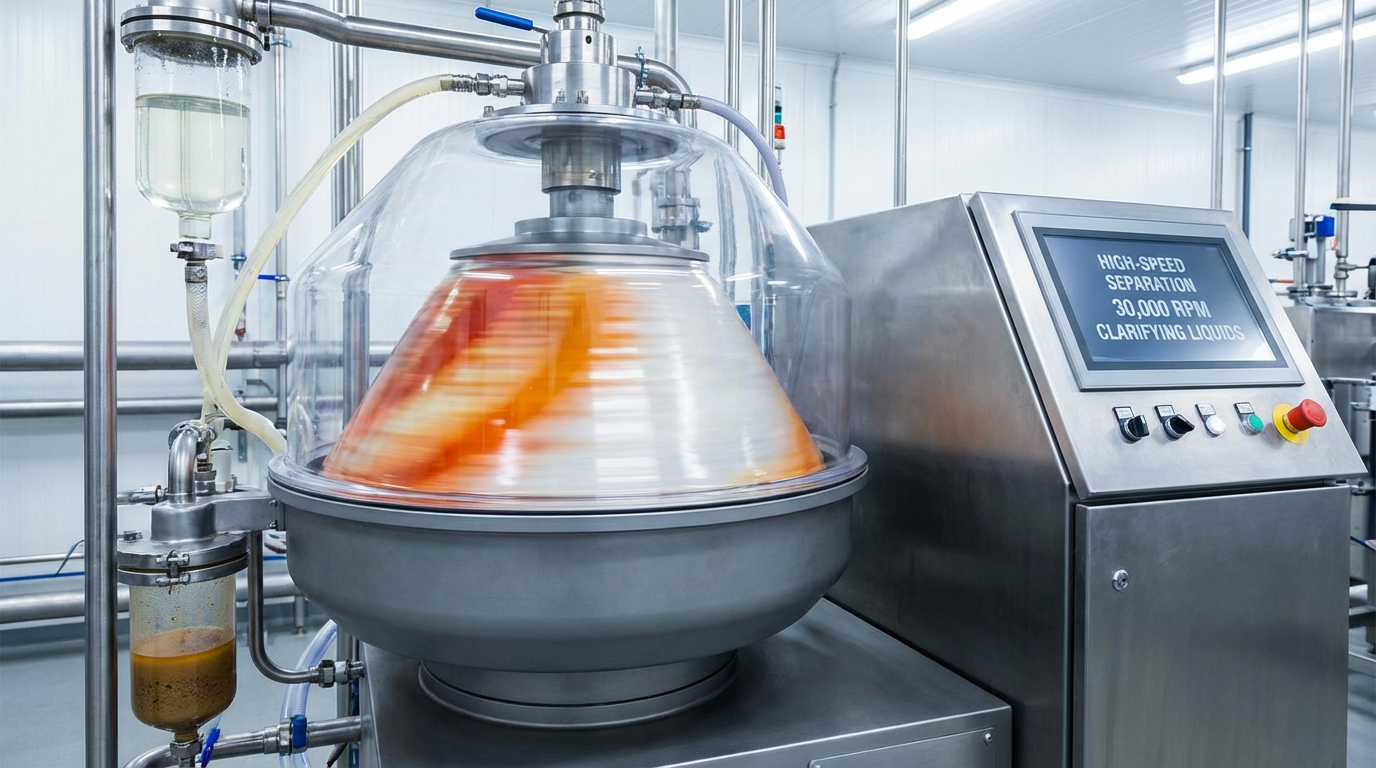
The basic idea behind a centrifuge is simple, just like spinning a bucket of water around without it spilling. But the industrial applications are incredibly advanced and vital. As an engineer with over 10 years in this field, I've seen firsthand how this technology transforms production lines. It's the hidden hero in so many products we use every day. Let's look at how it actually works in different situations.
How does centrifugation handle solid-liquid separation2?
Removing unwanted solids from liquids is a constant headache for many plants. Clogged filters and slow settling tanks can kill productivity. Centrifuges spin out solids instantly, keeping your process flowing.
Centrifugation1 excels at solid-liquid separation2 by using intense G-forces5 to push denser solid particles to the bowl's edge. The lighter, clarified liquid is then continuously removed. This process is far faster and more effective than simply letting gravity do the work.
The Decanter Centrifuge at Work
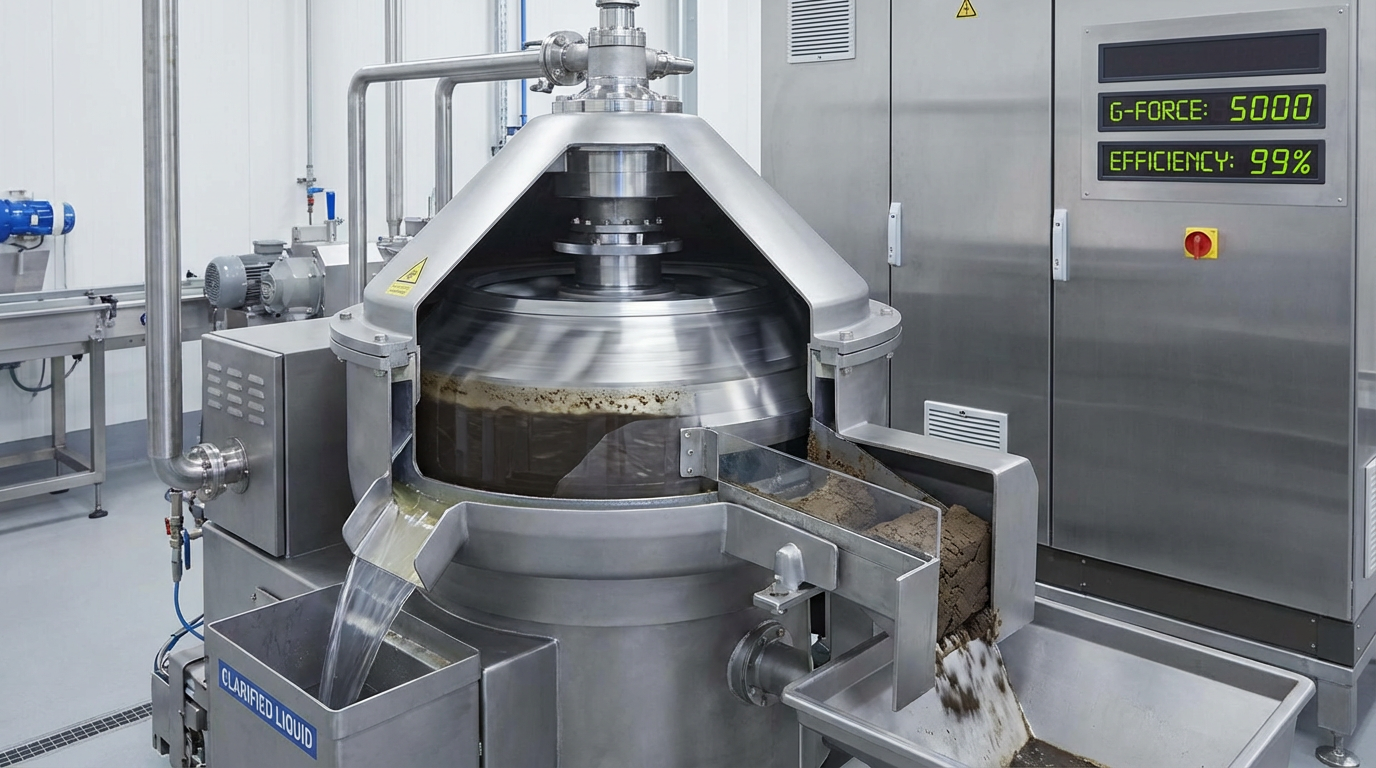
For heavy-duty solid-liquid separation2, the workhorse is often the decanter centrifuge6. Imagine a long, rotating bowl with a screw conveyor inside that spins at a slightly different speed. When we pump a slurry (a mix of liquid and solids) into it, the intense rotation pins the heavier solids against the wall of the bowl. The screw conveyor then scrapes these compacted solids, or "cake," toward one end for discharge. Meanwhile, the clarified liquid, or "centrate," flows out the other end. I've seen our decanters in wastewater treatment7 plants take in thin, watery sludge and discharge a thick, almost spadeable cake and surprisingly clear water. This dramatically reduces the volume of waste that needs to be disposed of, saving the plant significant costs.
Key Advantages Over Other Methods
The real power of centrifugation becomes clear when you compare it to older methods. Filtration can be effective, but filters clog and need constant replacement, leading to downtime. Gravity settling tanks are huge, slow, and can't handle high volumes efficiently. Centrifuges are compact, continuous, and incredibly fast.
| Feature | Centrifugation1 (Decanter) | Filtration | Gravity Settling |
|---|---|---|---|
| Speed | Very Fast (Continuous) | Slow to Moderate (Batch) | Very Slow |
| Footprint | Small | Medium | Very Large |
| Labor | Low (Automated) | High (Filter Changes) | Low |
| Efficiency | High | Varies, can clog | Low to Medium |
| Handles Slurry | Excellent | Poor to Fair | Fair |
This is why industries from municipal water treatment to mining and chemical processing rely on centrifuges. They provide a reliable, high-throughput solution for getting solids out of liquids.
Can centrifuges separate two different liquids?
Trying to separate two liquids that don't mix, like oil and water, can be a real challenge. Stubborn emulsions8 can form, and gravity separation can take hours or even days. A centrifugal separator breaks these emulsions8 and provides a clean split in seconds.
Yes, centrifuges are perfect for separating two immiscible liquids that have different densities. High-speed rotation multiplies the effect of gravity, forcing the heavier liquid outward and the lighter liquid inward, allowing for their separate and continuous removal.
How Disc Stack Separators Work
When we need to separate two liquids, or remove very fine solids from a liquid, we often turn to a disc stack separator9. Inside its bowl is a stack of cone-shaped discs. When we feed the liquid mixture into the separator, it flows into the gaps between these discs. This is the clever part. The discs create a huge surface area, which dramatically shortens the distance a particle or droplet has to travel to be separated. The heavier liquid (and any solids) are forced to the underside of the discs and slide outwards to the edge of the bowl. The lighter liquid is forced inwards, towards the center. Each liquid is then collected in a separate chamber and discharged.
The Milk Example: Purification and Skimming
The dairy industry is a perfect example. I remember visiting a dairy that was struggling with inconsistent cream content in their milk. We installed one of our disc stack separator9s, and the difference was night and day. Raw milk is fed into the machine. The centrifugal force separates it into three streams:
- Cream: The fat globules are the lightest component, so they move to the center.
- Skim Milk: The main body of the milk is heavier, so it moves toward the outside.
- Impurities: Any solid impurities like dirt or somatic cells are even denser, so they are thrown to the very edge of the bowl and periodically ejected as sludge.
The machine does all of this continuously, processing thousands of liters per hour. By adjusting the machine, the dairy can precisely control the fat content of their final product, whether it's whole milk, low-fat milk, or pure cream.
| Input | Process | Output 1 (Light Phase) | Output 2 (Heavy Phase) | Output 3 (Solids) |
|---|---|---|---|---|
| Raw Milk | Disc Stack Centrifugation1 | Cream (Fat) | Skim Milk | Somatic cells, dirt |
| Oily Water | Disc Stack Centrifugation1 | Purified Oil | Clean Water | Sludge |
This same principle is used to purify edible oils, treat oily wastewater from factories, and in countless other applications where two liquids need to be cleanly and quickly separated.
Why is centrifugation essential for biopharmaceuticals10 and food processing?
Your final product has to be pure, clear, and safe. Even tiny particles, bacteria, or cells can ruin an entire batch, costing you a fortune in time and materials. Centrifugation1 provides the high-purity clarification that these sensitive industries demand.
It's essential because it removes very fine particles like cells and cell debris without using filters that clog or chemicals that might contaminate the product. This ensures the purity, safety, and quality of products like vaccines, juices, beer, and plant-based milk11s.
Clarification in Biopharma
In the biopharmaceutical world, we're often dealing with incredibly valuable and sensitive materials. After a fermentation process12, for example, you might need to harvest valuable cells from the growth medium. Or, you might need to do the opposite: remove all the cells and cell debris to get a pure liquid product, like a protein or an enzyme used in a new drug. Using a filter for this is risky; it can clog easily, and the pressure can damage the delicate cells. A centrifuge, especially one designed for hygienic use, can handle this gently and efficiently. Our machines for this industry use high-grade 316L stainless steel13 and are designed to be easily cleaned and sterilized to prevent any cross-contamination14. The high G-forces5 can separate particles that are microscopic, ensuring the final product meets strict purity standards.
Clarification in Food and Beverage
The same need for clarity and purity exists in the food and beverage industry. Nobody wants cloudy juice, hazy beer, or sediment in their wine.
- Juice Production: Centrifuges are used to remove excess pulp and fine particles to create a clear, shelf-stable product.
- Beer & Wine: After fermentation, centrifuges remove yeast and other particles that cause haziness. This process is much faster than letting the particles settle on their own.
- Plant-Based Beverages: For products like oat milk or soy milk, centrifuges are crucial for removing coarse fibers and creating the smooth texture customers expect.
| Industry | Application | Goal |
|---|---|---|
| Biopharma | Cell Harvesting / Broth Clarification | Collect valuable cells or purify liquid product. |
| Juice | Pulp Removal | Create a clear, stable final product. |
| Beer / Wine | Yeast & Haze Removal | Achieve clarity and stabilize the product quickly. |
| Plant-Based Milk | Fiber Removal | Achieve a smooth, desirable texture. |
Understanding centrifugation can help you improve efficiency in separating materials in various industries. ↩
Learn how centrifugation can enhance your production line by efficiently separating solids from liquids. ↩
Discover how centrifuges can quickly and effectively separate immiscible liquids like oil and water. ↩
Explore how centrifugation ensures the purity and clarity of liquids in food and beverage industries. ↩
Understand how G-forces enhance the separation process in centrifugation, making it faster and more efficient. ↩
Find out how decanter centrifuges are used for heavy-duty solid-liquid separation in various industries. ↩
Discover how centrifuges reduce waste volume and save costs in wastewater treatment plants. ↩
Learn how centrifuges can quickly break stubborn emulsions, providing a clean separation of liquids. ↩
Learn about the disc stack separator's role in efficiently separating liquids and fine solids. ↩
Understand the importance of centrifugation in ensuring the purity and safety of biopharmaceutical products. ↩
Explore how centrifugation removes fibers to create smooth textures in plant-based milk products. ↩
Learn how centrifugation helps in harvesting cells and purifying products in fermentation. ↩
Understand the benefits of using 316L stainless steel in centrifuges for durability and hygiene. ↩
Explore the design features of centrifuges that prevent cross-contamination in sensitive applications. ↩